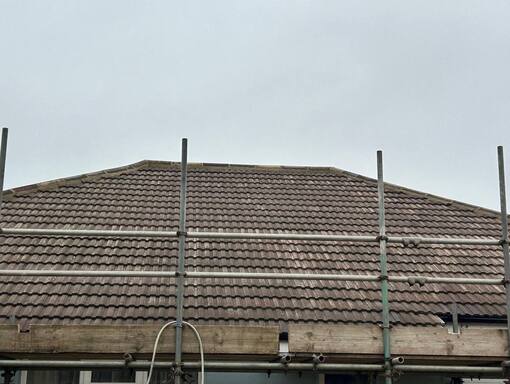
Roofing problems do not always develop in isolation. An older roof may have slipped tiles in one area, deteriorated underlay in another and recurring leaks around several junctions. Each defect might appear repairable on its own, but repeated localised work may become less dependable when the roofing system is deteriorating as a whole.
A roof replacement can address connected defects within one planned project. This does not mean that every roof with more than one problem needs replacing. For property owners in Heacham, Norfolk, the decision should follow a thorough inspection of the roof covering, supporting materials and internal roof space.
How Replacement Can Resolve Widespread Roofing Defects
Replacing a roof involves more than installing new tiles or slates. It provides access to the materials beneath the visible covering and allows the complete roof build-up to be assessed.
This makes it possible to correct several related weaknesses rather than repeatedly treating the most obvious symptom.
Replacing Deteriorated Tiles or Slates
Cracked, brittle or displaced tiles can reduce the roof’s ability to direct rainwater effectively. If only a small number are affected, targeted replacement may be sufficient.
When deterioration is widespread, however, neighbouring tiles may break during repair work or begin to fail shortly afterwards. Replacing the covering creates a consistent surface with the correct overlaps, alignment and fixings across the roof.
This can also resolve an uneven, heavily patched appearance caused by years of local repairs.
Renewing Failing Underlay
Underlay provides secondary protection beneath the roof covering. Over time, older materials may become brittle, tear around fixings or sag between rafters.
The condition of the underlay can be difficult to assess fully while the tiles remain in place. Roof replacement exposes this layer so that it can be renewed continuously rather than patched only where damage is accessible.
A correctly installed underlay helps manage any rain or wind-driven moisture that reaches beneath the main covering.
Repairing Damaged Battens
Tiles and slates rely on battens for support and secure fixing. Battens can split, decay or weaken following prolonged exposure to moisture.
Localised batten damage can often be repaired by lifting a limited area of the covering. If weakness extends across several sections, replacement allows the affected battens to be removed and new ones installed at the correct spacing.
This creates a dependable fixing point for the new roof covering and reduces the risk of recurring tile movement.
Improving the Security of Roofing Materials
Repeatedly slipping tiles may indicate that nails, clips or other fixings are failing across the roof. Replacing individual tiles will not solve the problem if the surrounding materials are also insecure.
During roof replacement, the fixing system can be renewed throughout. Tiles or slates can then be installed in accordance with the requirements of the chosen product and the roof’s level of exposure.
A consistent fixing approach helps the covering function as a complete system.
Correcting Weak Roof Junctions
Chimneys, valleys, abutments, roof windows and other junctions are common sources of water ingress. Older flashing may crack or pull away, while valley materials can deteriorate or become poorly aligned with previous repairs.
Replacing the roof provides an opportunity to renew these details alongside the main covering. This is particularly valuable when several junctions have become unreliable or patches no longer integrate properly with the surrounding materials.
The aim is to create continuous weather-resistant detailing rather than a collection of separate repairs.
Addressing Problems Along Ridges, Hips and Verges
Ridges, hips and verges protect exposed edges and changes in roof direction. If their fixings, mortar or supporting components deteriorate, tiles can become loose and water may reach vulnerable areas.
A replacement project can renew these details and connect them correctly to the rest of the roofing system. This helps improve overall stability and creates a more consistent finish.
Investigating Hidden Moisture Damage
Recurring leaks may affect insulation, roof timbers and other concealed materials. Removing the existing covering gives the roofer a clearer view of the roof deck and supporting structure.
Any damp, decayed or damaged sections can be identified before the new roof is installed. Treating these weaknesses at the same time prevents them from being concealed beneath a new covering.
The extent of remedial work should always be based on the actual condition found.
Improving Roof Space Ventilation
Condensation can sometimes be mistaken for a roof leak because both may cause moisture within the roof space. Inadequate ventilation can allow humid air to collect around the underlay and timbers.
Roof replacement provides an opportunity to review how the roof space is ventilated and incorporate suitable measures into the new system. The design must be considered as a whole so that ventilation, underlay and insulation work together correctly.
Creating Consistent Drainage Across the Roof
A roof relies on correct pitches, overlaps and junction details to guide water towards the drainage system. Uneven repairs or poorly matched materials can interrupt this flow.
Installing a complete replacement covering restores consistent water-shedding across the roof slopes. Eaves details can also be checked to ensure water reaches the drainage system rather than tracking behind it.
Reducing the Cycle of Unrelated Repairs
A roof that develops a new fault in a different place every year may no longer be suitable for isolated patching. Although each repair can solve an individual problem, the surrounding materials may continue to deteriorate.
Replacement can remove this inconsistency by renewing components that are reaching the end of their serviceable condition together. However, it should only be recommended when a professional assessment shows that broader work will provide a more reliable result than further local repairs.
When Are Repairs Still the Better Choice?
Several visible defects do not automatically make replacement necessary. Localised repairs may remain appropriate when:
- The main roof covering is still sound
- Damage is limited to clearly defined areas
- Battens and underlay remain serviceable
- Leaks have identifiable, repairable causes
- The roof structure is in good condition
- Previous repairs have not revealed widespread deterioration
A trustworthy assessment should explain why repair or replacement is appropriate based on the condition of the complete roof.
What Should Be Assessed Before Replacement?
Before work is planned, the roof should be examined for:
- The condition of tiles or slates
- The security of fixings
- Underlay and batten deterioration
- Leaks and internal moisture damage
- Flashing and roof junction defects
- Ridge, hip, verge and valley condition
- Ventilation performance
- Movement within the supporting structure
These findings determine whether replacement can meaningfully address several connected problems.
Conclusion
A roof replacement can resolve multiple issues by renewing the covering, underlay, battens, fixings and vulnerable junctions as one coordinated system. It can be particularly suitable when defects are widespread and continued patch repairs are unlikely to provide dependable protection.
Heacham Roofing Services provides professional roof inspections, repairs and replacements in Heacham, Norfolk. If your roof has developed several recurring problems, contact our team to arrange an assessment and receive clear guidance on the most appropriate solution.
Call us on: 01485 506 937
Click here to find out more about Heacham Roofing Services
Click here to complete our contact form and see how we can help with your roofing needs.